The sacred sites of Makkah, the Mashair and Madinah: what is performed at each, and the history that makes standing at the rest worth something.
Informational summary, not a religious ruling. Where the schools of law differ, both positions are named. For anything affecting the validity of your Hajj, ask a qualified scholar or your group's guide.
Performed here · On arrival, after Arafah, and before departure
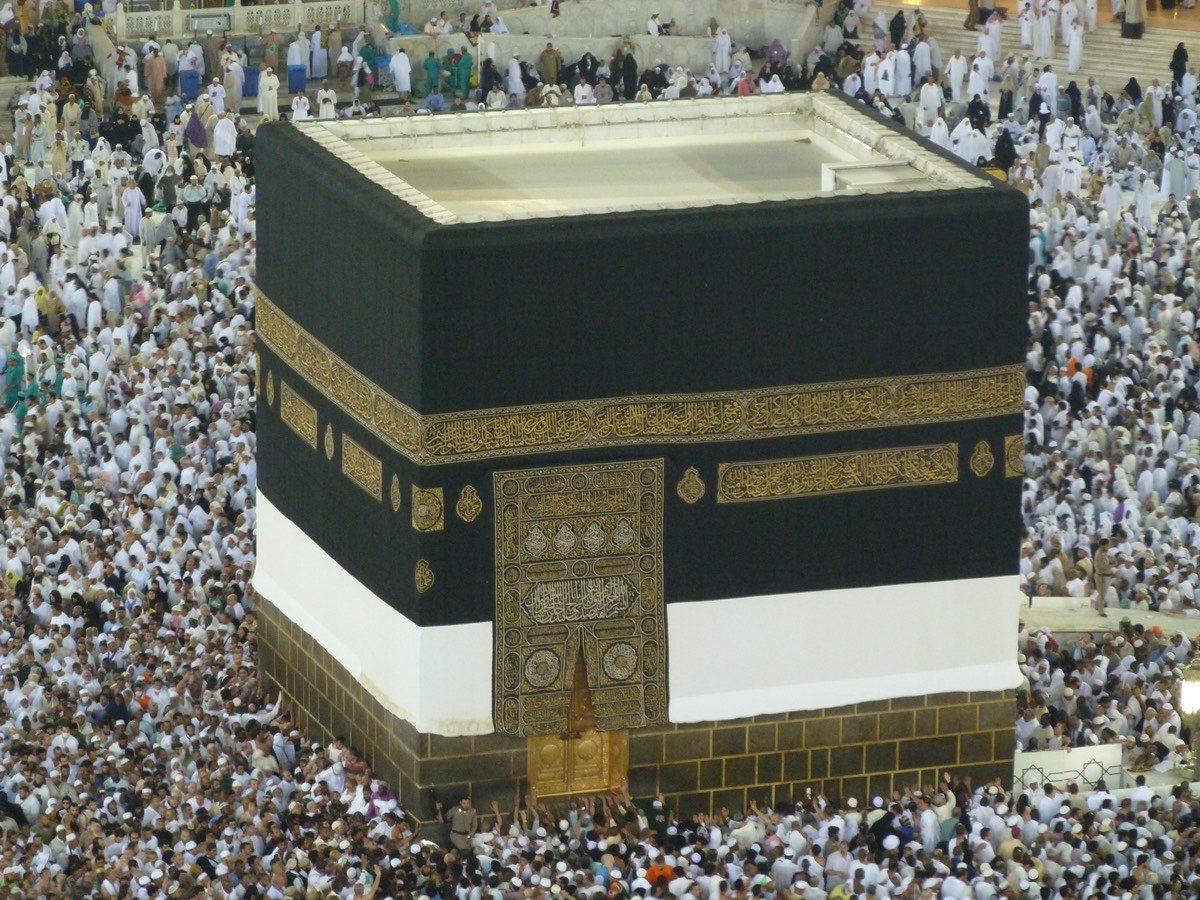
Tawaf
Seven circuits anticlockwise, beginning and ending level with the Black Stone. Men uncover the right shoulder and walk briskly in the first three circuits of an arrival tawaf.
The Qur’an describes the Kaaba as raised by Ibrahim and his son Isma‘il as the first house appointed for the worship of God. It has been rebuilt several times: by the Quraysh in the Prophet’s ﷺ youth, when he settled the dispute over who would place the Black Stone by having the clans carry it together on a cloak, and again by Ibn az-Zubayr and al-Hajjaj in the first century of Islam. The kiswa, the black covering with its gold calligraphic band, is replaced each year.
It is not worshipped; it is the direction of worship. Every prayer offered anywhere on earth faces this point, and the tawaf is the only rite in Islam performed around a physical object, which is why the crowd here is the densest a pilgrim will experience.
Al-Hajar al-Aswad
الحجر الأسود
Eastern corner of the Kaaba
Performed here · At the start of each circuit of tawaf
Istilam
Kiss it if you can reach it without harming anyone; touch it if you can; otherwise point toward it and say “Allahu akbar”. Pointing is complete.
Set into the eastern corner of the Kaaba, in a silver frame added after the stone was broken in the seventh century. ‘Umar ibn al-Khattab is reported to have addressed it directly: a stone that can neither benefit nor harm, kissed only because the Prophet ﷺ kissed it.
The starting line of the tawaf. Every year people are injured trying to reach it. The scholarly advice in modern crowds is near-unanimous: point from where you are.
Maqam Ibrahim
مقام إبراهيم
Beside the Kaaba
Performed here · Immediately after completing seven circuits
Two rak‘ah after tawaf
Pray two units behind the Station if there is room. If there is not (and usually there is not), anywhere in the mosque is fine.
A stone, held in a gold-and-glass enclosure, bearing what is traditionally understood as the impression of Ibrahim’s feet from when he stood on it to raise the walls of the Kaaba.
Named directly in the Qur’an as a place of prayer. It is one of the most congested square metres on earth during Hajj, and crowding it is a common cause of injury.
Hijr Isma‘il
حجر إسماعيل
Northern side of the Kaaba
No rite is performed here
The semicircular low wall on the northern side, also called the Hateem. It encloses ground that formed part of the original Kaaba built by Ibrahim; the Quraysh shortened the structure when they rebuilt it because they ran out of lawfully-earned funds. The Prophet ﷺ told ‘A’ishah that were his people not so recently out of disbelief, he would rebuild it to include this ground.
Because it is part of the Kaaba, praying inside it is praying inside the Kaaba itself, and tawaf must go around the outside of this wall, not between it and the building. Cutting through it invalidates the circuit, and it is one of the more common errors.
The Well of Zamzam
زمزم
Masjid al-Haram
Performed here · After tawaf, and freely throughout
Drinking Zamzam
Drink your fill. It is sunnah to drink standing, facing the qiblah, in three breaths.
Traced to Hajar, left in the barren valley with the infant Isma‘il, running between Safa and Marwah in search of water until a spring broke open at the child’s feet. The well has run continuously ever since and now supplies dispensers throughout the Haram.
Practically as well as spiritually important: in 45°C heat, free cold water throughout the mosque is a public-health intervention, and pilgrims should use it far more than they typically do.
Safa and Marwah
الصفا والمروة
The Mas‘a, within Masjid al-Haram
Performed here · After tawaf, in both Umrah and Hajj
Sa‘i
Seven passages, starting at Safa and ending at Marwah. Men jog between the two green markers; everyone walks the rest. The full course is about 3.5 km.
Two small hills, now enclosed within the mosque and connected by an air-conditioned gallery. This is Hajar’s path: seven times between them, searching the horizon for water or a caravan.
The rite commemorates a mother’s search for water for her child. It is worth saying plainly that one of the five pillars of Islam contains, at its centre, the re-enactment of a woman’s desperation and her refusal to give up.
Performed here · 8 Dhul Hijjah, and the nights of the 11th–13th
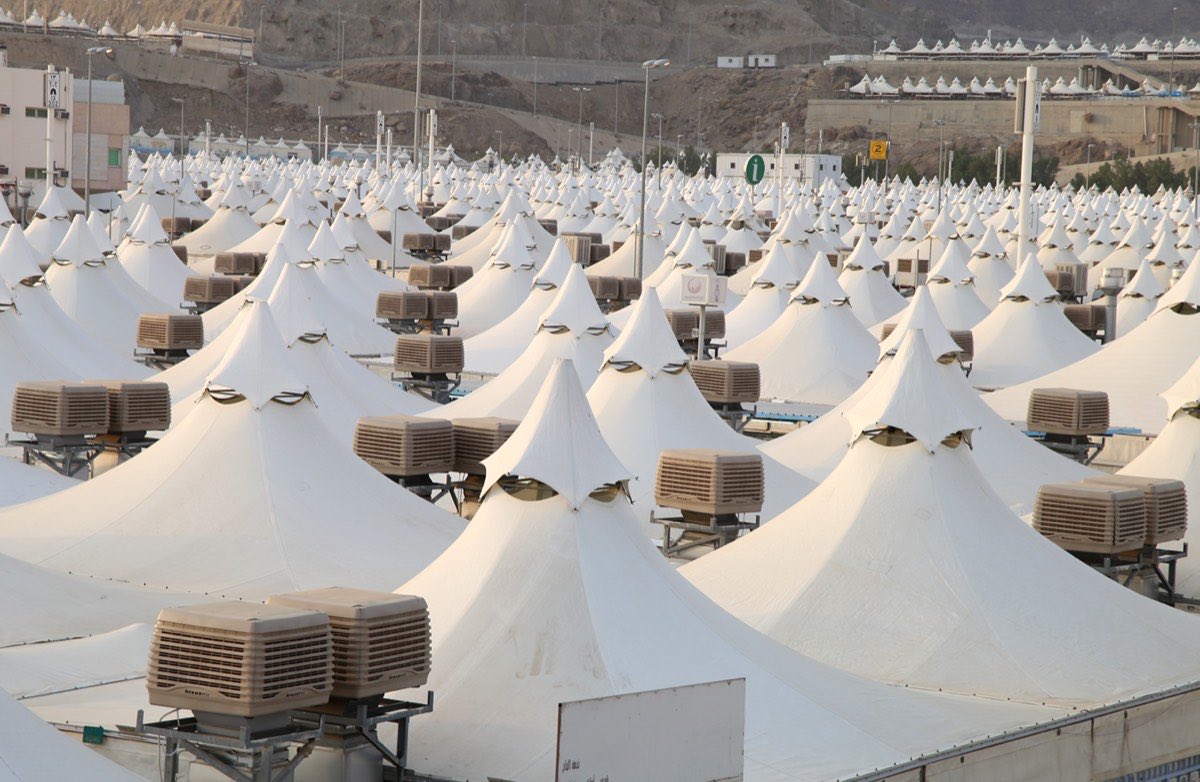
Staying at Mina
Remain within the boundary. Prayers of four rak‘ah are shortened to two. The nights of tashriq are spent here.
A valley of roughly twenty square kilometres, empty for most of the year and the largest temporary city on earth for five days of it. Over a hundred thousand fireproof fabric tents, permanently installed, air-conditioned since the 1990s.
This is where pilgrims most often become separated, and the reason is architectural rather than careless: the tents are near-identical, the lanes repeat, there are no landmarks, and it is dark. Fix your camp number and your street in your memory, and do not rely on recognising the way back.
Performed here · 10 Dhul Hijjah (the large pillar only), then all three on the 11th–13th after midday
Ramy al-Jamarat
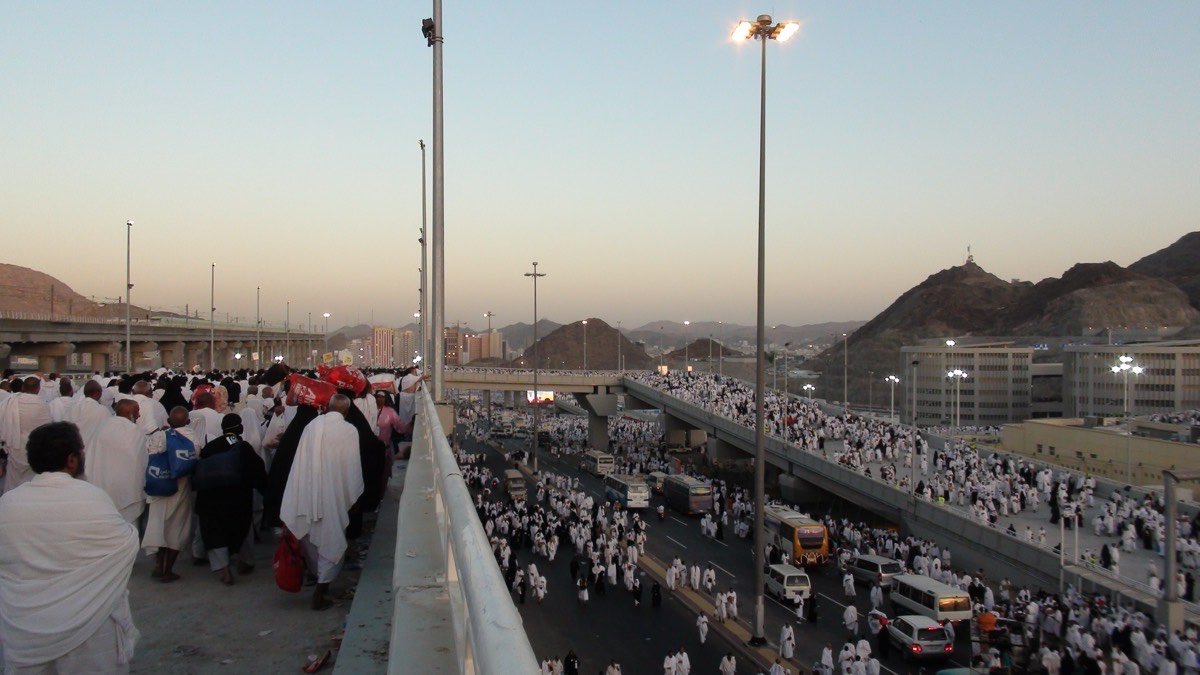
Seven pebbles at each pillar, thrown one at a time, saying “Allahu akbar” with each. On the days of tashriq take them in order: the small, the middle, then al-Aqabah.
Three pillars marking where Ibrahim is said to have driven away the whisper to disobey the command concerning his son. After repeated crushes, the worst in 1990 and 2015, the site was rebuilt as a multi-level bridge with one-way flow, separate entry and exit ramps, and pillars elongated into walls so more people can throw at once.
The rite is a rejection, not an attack on an object. The engineering exists because directional crowd flow at this density is genuinely dangerous: go with your group at the time your leader sets, not at the time that suits you.
Performed here · 9 Dhul Hijjah, from midday until sunset
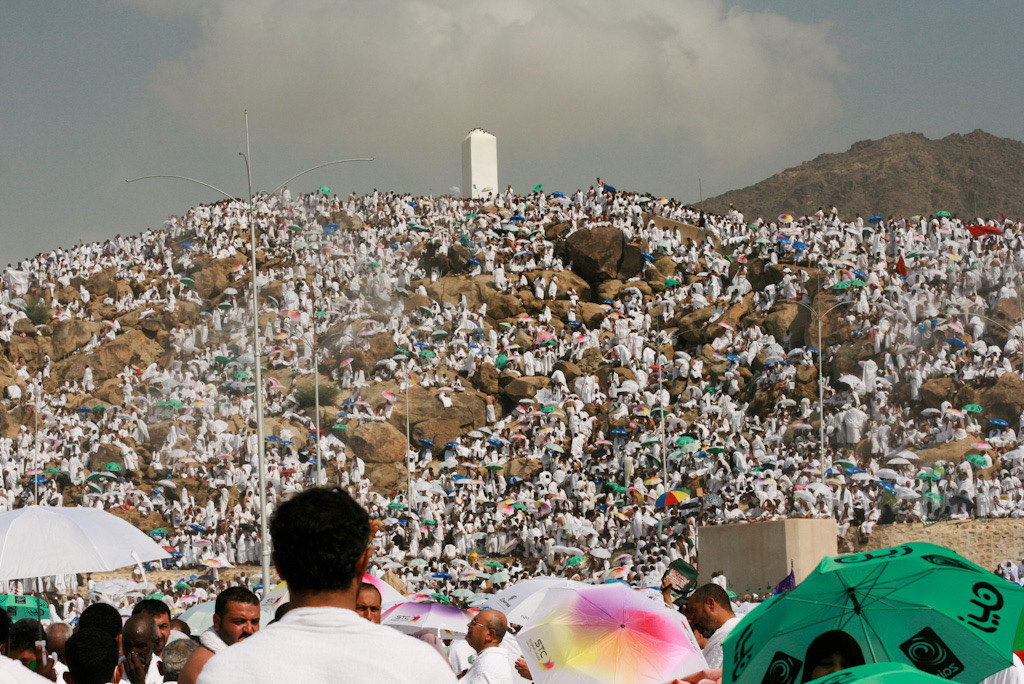
Wuquf
Be present within the boundary and make du‘a. Dhuhr and ‘Asr are combined and shortened at Dhuhr’s time. Do not leave before sunset.
The plain where the Prophet ﷺ delivered the Farewell Sermon in the tenth year after the migration, from the back of his camel, to something over a hundred thousand people. Jabal ar-Rahmah, the Mount of Mercy, is the granite hill at its edge.
“Hajj is Arafah.” A pilgrim who stands here for any part of the period has performed the essential act; one who misses it has missed the Hajj entirely, whatever else they did. It is also the single most dangerous day for heat: hours in the open, at the hottest point of the year.
Masjid Namirah
مسجد نمرة
Western edge of Arafah
Performed here · 9 Dhul Hijjah, midday
The sermon and combined prayer
The Hajj sermon is delivered here, followed by Dhuhr and ‘Asr combined.
Built on the site where the Prophet ﷺ camped before the Farewell Sermon. It is one of the largest mosques in the world and stands empty for all but one day of the year.
Note that its western portion lies outside the boundary of Arafah. Pilgrims who pray at that end and then leave have not necessarily completed the wuquf. Stay inside the marked boundary until sunset.
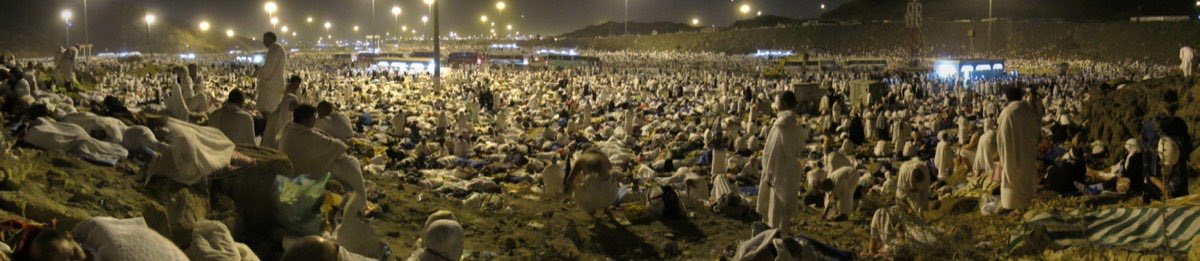
Pray Maghrib and ‘Isha combined on arrival. Rest under the open sky. Gather pebbles for the stoning. Leave after Fajr. The weak, the elderly and their companions may leave after midnight.
Open ground with no permanent accommodation. Al-Mash‘ar al-Haram, named in the Qur’an, stands within it.
The one night of Hajj spent on bare ground under the sky, with no tent and no comfort, by kings and labourers alike. It is also the period when the mobile networks are least usable, which is why a device that buffers its position rather than simply losing it matters here more than anywhere.
Masjid al-Khayf
مسجد الخيف
Mina
No rite is performed here
The principal mosque of Mina, at the foot of the mountain on the southern side of the valley. A tradition holds that seventy prophets prayed here.
No rite is attached to it, and praying here is not required. It is simply the mosque of the valley you are staying in, and a useful landmark in a place that has almost none.
Jabal an-Nur
جبل النور
North-east of the city · the Cave of Hira
No rite is performed here
The Mountain of Light, and near its summit the cave of Hira, where the Prophet ﷺ withdrew to reflect and where, at the age of forty, the first verses of the Qur’an were revealed to him: “Read, in the name of your Lord who created.”
There is no rite here and climbing it is not part of Hajj. Pilgrims climb it as a sunnah, because the Prophet ﷺ himself was here. The schools weigh that description differently, so ask your group’s scholar where they stand. If you make the attempt (a steep, exposed climb in extreme heat), go early, take water, and understand that you are performing sunnah rather than fard: a voluntary devotion, never an obligation of Hajj.
Jabal Thawr
جبل ثور
South of the city · the Cave of Thawr
No rite is performed here
The cave where the Prophet ﷺ and Abu Bakr hid for three nights during the migration to Madinah, with the Quraysh search parties close enough to be heard outside. This is the moment the Qur’an refers to as “the second of two, when they were in the cave”.
No rite. A harder climb than Jabal an-Nur and, in Hajj season, an unwise one.
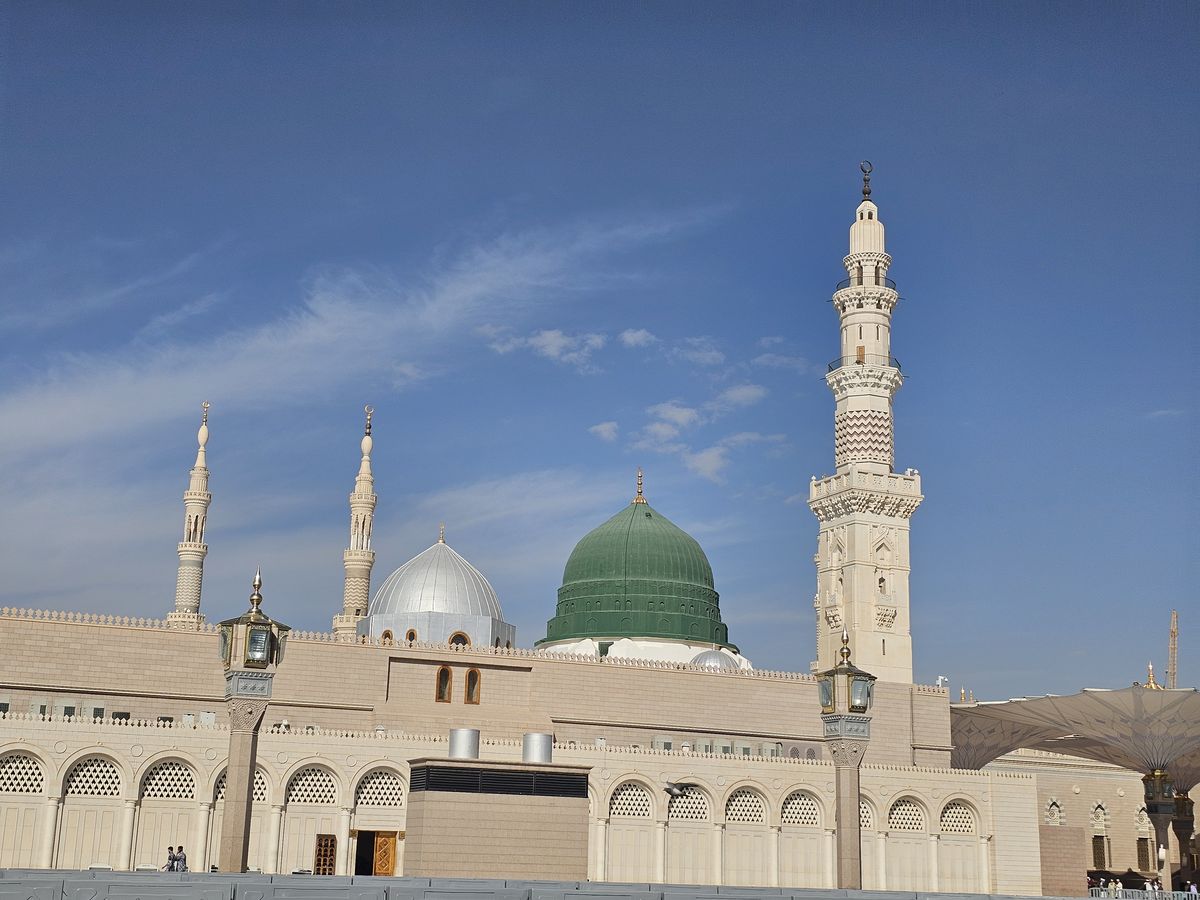
Built by the Prophet ﷺ himself on his arrival in Madinah, beside his house. He is buried in the chamber of ‘A’ishah, beneath the green dome, alongside Abu Bakr and ‘Umar. The mosque has been expanded repeatedly and now holds over a million people.
A visit of great merit, made by nearly every pilgrim. The Rawdah, between the Prophet’s chamber and his pulpit, is described in hadith as a garden from the gardens of Paradise; access is now by timed permit.
Masjid Quba
مسجد قباء
South of the city
No rite is performed here
The first mosque built in Islam, founded by the Prophet ﷺ in the days immediately after his arrival, its foundations laid by his own hands.
A hadith records that praying two rak‘ah here carries the reward of an Umrah. Not a Hajj rite, but among the most visited places in Madinah.
Masjid al-Qiblatayn
مسجد القبلتين
North-west of the city
No rite is performed here
The Mosque of the Two Qiblahs, where the command came mid-prayer to turn from Jerusalem toward the Kaaba. The congregation turned where they stood and completed the prayer facing Makkah.
The physical record of the moment the direction of prayer changed for every Muslim thereafter. No rite attaches to it.
Mount Uhud
جبل أحد
North of the city
No rite is performed here
The site of the battle of Uhud in the third year after the migration, where the Muslims were defeated after archers left their position, and where Hamzah ibn ‘Abd al-Muttalib and some seventy others were killed. They are buried at the foot of the mountain.
The Prophet ﷺ said of it: “Uhud is a mountain that loves us and that we love.” No rite attaches to visiting, and it is a place to reflect rather than to perform anything.